


Why I Wrote the 'Stuff' Series...

It is simple, really. For about twenty-seven years, I have worked in education in various roles, from teacher to school leader, and as someone who has spent a considerable amount of time listening to children who experience the world in different ways. I now run my own tutoring company with a wonderful bank of tutors.
I have sat beside children who couldn’t quite explain what they were feeling. Children who were told they were too much, too loud, too sensitive, or too easily distracted and didn’t listen properly. Children who tried their hardest to fit into classrooms that weren’t always built for them.
I remember thinking the same thing over and over again as a teacher: Where are their stories?
Not the dramatic, flashy ones.Not the tragic, sad ones.And certainly not the ones about being fixed or made different to the norm.
I just wanted honest stories about what it feels like to be a child with these difficulties.
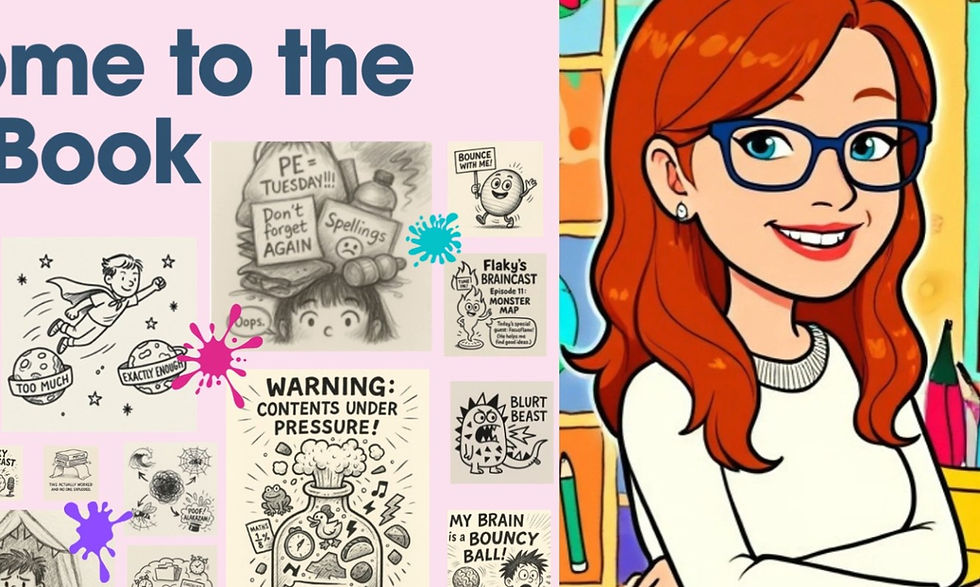
Writing through two lenses
I started writing through two lenses. While I was studying for my Master’s in Educational Psychology, I found myself reflecting more deeply and writing with a more focused psychological lens than ever before.
I wasn’t just writing as an author. I was writing as:
a teacher who had seen the everyday realities of school life and the struggles these children face
a school leader who understands the systems around the child and the frustrations teachers feel, and the demands on their time and energy
a parent who feels the struggles my own child and step-children face with the school system
and someone looking at behaviour, emotion and development through an educational psychologist's lens
Really, the Stuff series grew out of that space, a space where education meets empathy.
Summer and Joshua
I started with Summer Matthews in Stuff I Can’t Say Out Loud.
She is a girl who often masks her feelings. Masking is common with girls with ADHD, and although she is undiagnosed in the book, it is clear she has inattentive ADHD. She notices everything, feels everything deeply, and often worries too much about the world around her.
I really wanted to get her story out there because I have seen so many girls struggle with this – and boys too – but particularly girls who reach the higher years of primary school. They often appear to be the “perfect student”, but underneath, there is an emotional battle going on. Parents frequently report emotional overload when they get home from school.
Then there is Joshua Flakerton, in Stuff That Won’t Stay Still. He represents the hyperactive side of ADHD. He struggles with constant movement, impulsivity, and the frustration of trying to sit still in a classroom that doesn’t always make sense to him.
Neither of these characters are perfect, but equally, neither of them are problems to be solved, needs a label, or needs to be fixed. They are just children trying to get through the school day.
Not about fixing – about understanding
I really wanted to make sure my writing was not about fixing children or labelling them, but about understanding them. That was one thing I wanted to make very clear from the start. I didn’t want these to be “issue books”. The aim was never to diagnose, label or offer neat solutions.
The aim was to write stories that quietly said:
You’re not broken. You’re not alone. You deserve to be understood.
I wanted children to identify with the characters and see themselves in the stories. I wanted parents to recognise that they are not alone, and that their child isn’t “failing at school” – they just need to be understood. And I wanted teachers to nod along, gain ideas, and feel supported, even when they are teaching thirty other children. Children deserve to be understood. Parents deserve to be recognised. And teachers deserve recognition for the phenomenal job they do.
But most importantly, children deserve stories where they can see themselves.
Why these stories matter
These stories matter because neurodivergent children don’t need more pressure to change who they are. They need more spaces where they feel safe to be who they already are.
If the Stuff series does one thing, I hope it’s this:
That a child somewhere reads it and thinks, Oh, it’s not just me. That an adult reads it and thinks, I understand a little more now. And that a teacher reads it and thinks, I’m going to try that in my classroom. That would be amazing. And that feels like enough for me as a writer.
The heart of it all
At the heart of it all, the Stuff series exists because of the children I’ve taught, the families I’ve worked with, and the classrooms I’ve lived in for most of my adult life. These books are my way of saying thank you to all of them – and of making space for stories that often go unheard.
It has been incredibly emotional seeing the response so far, especially reaching the top 50 on Amazon. I’m so grateful for the support and feedback.
And I can’t wait to explore Emily McCloud’s story (Book 3 in the 'Stuff' series) next – a child with autism, set once again at Riverstone Primary School, a fictional Cornish primary school shaped by the rolling hills and coastline I love. Cornwall and the sea are central to all my writing, whether children’s or adult fiction. I wanted Riverstone to feel like a real Cornish school, because place matters deeply to me.
Emily is a wonderful character, and book three is on its way – with more strategies for teachers, more representation for children, and more stories where young readers can finally see themselves.
That’s why I wrote the Stuff series. And I hope it continues to resonate.
Bren xoxo


Comments